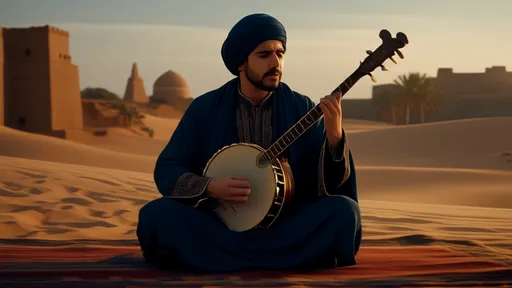
The air trembles with a sound that seems to both mourn and celebrate existence itself—a single voice, a lone instrument, tracing a path through notes that Western ears might find unfamiliar, even unsettling. This is the world of Arabic Maqam, a complex system of melodic modes that has for centuries given voice to the profound dualities of human experience. Unlike the fixed scales of Western tradition, maqamat (the plural of maqam) are not merely sequences of notes; they are emotional landscapes, spiritual journeys, and cultural narratives woven into sonic form. They are the vessels through which Arab music expresses the deepest shades of feeling, where the ecstasy of divine connection and the ache of earthly separation are not opposites but two sides of the same, deeply felt coin.
To understand maqam is to move beyond the concept of a simple scale. A maqam is defined by its unique intervalic structure—the specific, and often microtonal, distances between its notes. These are not the uniform half-steps and whole-steps of the piano. Instead, they include quarter-tones, three-quarter-tones, and other nuanced intervals that give each maqam its distinctive colour and flavour, its tarab—a state of musical enchantment or ecstasy. Crucially, a maqam is also defined by its melodic pathway. It has a hierarchy of important notes: a tonic (qarar), a dominant (ghammaz), and a central note for development (markaz). The artistry lies not in running up and down the scale, but in how the musician navigates between these pillars, emphasising certain phrases, dwelling on particular emotional centres, and building tension and release through melodic, rather than harmonic, movement.
The emotional power of maqamat lies in their inherent ability to conjure specific moods, a concept known as ta'thir. Certain maqamat are famously associated with particular feelings. Maqam Rast, for instance, often centred on a stable, firm tonic, is frequently described as conveying a sense of pride, masculinity, and contentment. It is a grounding force. In stark contrast, Maqam Bayati, with its slightly raised fourth degree, evokes a profound sense of yearning, nostalgia, and tender sadness—the sound of a soul longing for its origin or a lost love. Then there is Maqam Saba, a mode notorious for its tense, unstable intervals, particularly a lowered second and fifth. Saba is the sound of deep pain, tragedy, and lamentation; it is the maqam of funeral dirges and heart-wrenching poetry.
Yet, to assign a single emotion to a maqam is to miss the point entirely. The true genius of the system is its capacity for modulation (intiqal). A skilled performer will not stay in one maqam for an entire performance. Like a master storyteller shifting the narrative tone, the musician will journey from one maqam to another, often through shared notes or common phrases. A performance might begin in the melancholic embrace of Bayati, slowly building in intensity until it modulates into the more passionate and fiery Maqam Hijaz. This movement from one emotional world to another creates a dynamic narrative arc. The initial sadness is not erased; it is transformed, becoming the fertile ground from which joy or ecstasy can grow. This fluid movement between emotional poles is what gives Arabic music its breathtaking depth, mirroring the human capacity to hold multiple, conflicting emotions simultaneously.
The experience of this emotional journey is encapsulated in the concept of tarab. Tarab is far more than just listening; it is a state of transcendent emotional communion between the artist and the audience. It is the collective sigh that ripples through a crowd when a violinist sustains a perfectly pitched quarter-tone, the shout of "Allah!" that escapes from a listener when a singer’s voice cracks with raw emotion, the trance-like state where individuals are overcome by the beauty and pain of the music. Tarab is the ultimate goal. It is the proof that the melody has successfully travelled from the realm of technical structure into the realm of the human spirit, blurring the lines between performer and listener, between individual sorrow and collective catharsis. It is in these moments of tarab that the duality of maqam becomes most apparent—the shared experience of pain becomes a source of profound joy and connection.
The transmission of this intricate art form has historically rested on the master-apprentice relationship and the renowned oral tradition. Maqam is a living, breathing entity that is learned not from sheet music, but through listening, imitation, and osmosis. A student (tilmīdh) will spend years alongside a master (ustadh), absorbing the subtle nuances of intonation, the precise ornamentation (tahsinat), and the art of improvisation (taqsim) that are the heart of the tradition. This method ensures that the emotional and microtonal subtleties—the very soul of the maqam—are preserved and passed down through generations. It is a knowledge held in the body and the ear, a felt understanding rather than an intellectual one.
In the contemporary soundscape, the language of maqam continues to evolve while retaining its soul. It provides the foundational grammar for the compositions of legendary figures like Umm Kulthum and Fairuz, whose epic songs are masterclasses in melodic development and emotional modulation. Today, forward-thinking artists across the Arab world and in global fusion projects are engaging in a vibrant dialogue with the tradition. They are weaving the ancient emotional pathways of maqamat with electronic beats, jazz harmonies, and orchestral arrangements. This is not a dilution but a expansion, a testament to the system's incredible flexibility and enduring power. These modern explorations prove that the maqam’s capacity to express the complexities of the human condition is not locked in the past but is a vital, dynamic force for contemporary expression.
Ultimately, the journey through the world of Arabic Maqam is a journey into the heart of a philosophical and aesthetic worldview that embraces emotional complexity. It rejects the simplistic binary of happy versus sad. Instead, it understands that profound joy can be born from shared sorrow, that spiritual ecstasy often arises from a feeling of lack, and that the most beautiful melodies are those that acknowledge the full spectrum of what it means to be alive. The maqam, in all its nuanced glory, remains one of humanity's most sophisticated tools for exploring the infinite landscape of the heart, a timeless mirror reflecting the beautiful, painful, and exquisite dance between sorrow and bliss.

By /Aug 22, 2025
By /Aug 22, 2025

By /Aug 22, 2025

By /Aug 22, 2025
By /Aug 22, 2025
By /Aug 22, 2025

By /Aug 22, 2025

By /Aug 22, 2025

By /Aug 22, 2025
By /Aug 22, 2025

By /Aug 22, 2025

By /Aug 22, 2025
By /Aug 22, 2025

By /Aug 22, 2025

By /Aug 22, 2025

By /Aug 22, 2025

By /Aug 22, 2025

By /Aug 22, 2025

By /Aug 22, 2025
By /Aug 22, 2025
