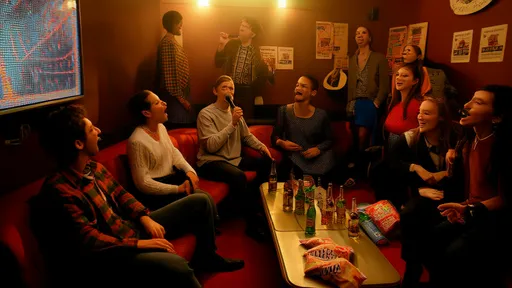
In the dimly lit rooms of karaoke bars across the globe, there exists an unwritten canon of songs that seem to transcend time, culture, and even musical taste. These are the anthems that, without fail, find their way onto the screen night after night, shouted by groups of friends, crooned by solo performers, and belted out by those who’ve had just enough liquid courage to take the mic. This phenomenon isn’t merely a matter of popularity; it’s a fascinating interplay of psychology, social dynamics, and what can only be described as ‘KTV Economics’—the underlying forces that dictate the supply and demand of shared musical experiences.
The allure of these perennial hits begins with a concept deeply rooted in our psychology: the mere-exposure effect. We tend to develop a preference for things simply because we are familiar with them. A song like Queen’s “Bohemian Rhapsody” or Whitney Houston’s “I Will Always Love You” isn’t just a song; it’s a cultural touchstone. We’ve heard it in movies, at weddings, on the radio during childhood car rides, and yes, in countless karaoke sessions. This constant, low-grade exposure breeds not just recognition, but comfort and a sense of nostalgic ownership. When we see it on the playlist, it feels like an old friend—a safe, reliable choice in the high-stakes social arena of the KTV room, where performing a unknown, complex song can be a risky gamble.
This sense of safety is paramount. Karaoke is a unique social contract. It’s about participation, not perfection. The goal is collective enjoyment, not a critique of vocal prowess. The eternal hits are almost always engineered for this very purpose. They possess a specific musical architecture: a memorable, often simple melody that is easy to grasp, a chorus that is powerfully anthemic and repetitive, and emotional crescendos that allow even the most tone-deaf singer to channel their inner rock god through sheer passion. Think of the collective catharsis of screaming the final “Hey Jude, na na na na…” or the playful, call-and-response nature of Journey’s “Don’t Stop Believin’.” These songs are built for group participation. They are less a performance and more a shared ritual, breaking down social barriers and forging a temporary community through synchronized singing.
This is where the ‘economics’ truly comes into play. The KTV ecosystem—comprising the bars, the song selection systems, and the publishers—operates on a model that reinforces this cycle of demand and supply. The most-requested songs are the lifeblood of their business. Therefore, their systems are deliberately curated to make these hits the most visible and accessible. They are prominently featured on the main menu, under categories like “Top 100,” “All-Time Favorites,” or “Staff Picks.” This creates a powerful feedback loop. The songs are popular, so they are promoted. Because they are promoted, they get sung more, cementing their popularity further. It’s a self-fulfilling prophecy that ensures the classics never fade from the spotlight.
Furthermore, the very act of choosing a song in a group setting is a subtle exercise in game theory. Individuals are making calculated decisions based on what they believe the group will approve of and enjoy. Selecting an obscure B-side from a niche artist is a selfish move—it serves the individual’s taste but risks alienating the group. Conversely, picking a certified crowd-pleaser is a strategic play for social capital. It signals that you are a team player, that you understand the collective mood, and that your primary goal is to contribute to the group’s fun. The eternal hit, therefore, becomes a currency of social goodwill. It’s the safest, most lucrative investment one can make in the economy of the karaoke room.
Nostalgia is the currency’s gold standard. These songs are often not chosen for their musical complexity but for their ability to transport a group back in time. Bon Jovi’s “Livin’ on a Prayer” might evoke college parties, while Spice Girls’ “Wannabe” screams 90s childhood. This shared nostalgic value is incredibly potent. It creates an immediate, unspoken bond among singers, even if they’ve just met. The song becomes a vessel for collective memory, making the karaoke performance less about the song itself and more about re-living a shared, or at least universally understood, moment in time. This emotional resonance guarantees its place on the playlist for decades.
Finally, we cannot ignore the role of pure, unadulterated cultural osmosis. The titles we’ve mentioned are more than songs; they are myths. Their legends are bolstered by iconic music videos, legendary live performances, and their use in pivotal film scenes. When someone chooses “My Heart Will Go On” from Titanic, they aren’t just choosing a song; they are buying into the entire epic romance of Jack and Rose. This layers the performance with a pre-packaged drama and emotion that elevates it beyond a simple sing-along. The song carries its own baggage—a history and a grandeur that the performer gets to borrow for three glorious minutes.
In conclusion, the eternal KTV hit is a masterpiece of social and psychological engineering. It is a perfect storm of familiarity, musical accessibility, strategic promotion, and deep emotional nostalgia. It thrives within an economic system designed to perpetuate its demand. These songs are the pillars of the karaoke world because they understand their audience perfectly. They know we are not there to be flawless vocalists; we are there to connect, to remember, and to shout into a microphone with friends, reassured by the comforting, timeless chords of a song everyone knows by heart.
By /Aug 22, 2025

By /Aug 22, 2025
By /Aug 22, 2025

By /Aug 22, 2025
By /Aug 22, 2025
By /Aug 22, 2025

By /Aug 22, 2025
By /Aug 22, 2025

By /Aug 22, 2025

By /Aug 22, 2025

By /Aug 22, 2025
By /Aug 22, 2025
By /Aug 22, 2025

By /Aug 22, 2025

By /Aug 22, 2025
By /Aug 22, 2025
By /Aug 22, 2025

By /Aug 22, 2025
By /Aug 22, 2025
By /Aug 22, 2025
